
 EN
EN DE
DE IT
IT FR
FR ES
ES RU
RU JP
JP RO
RO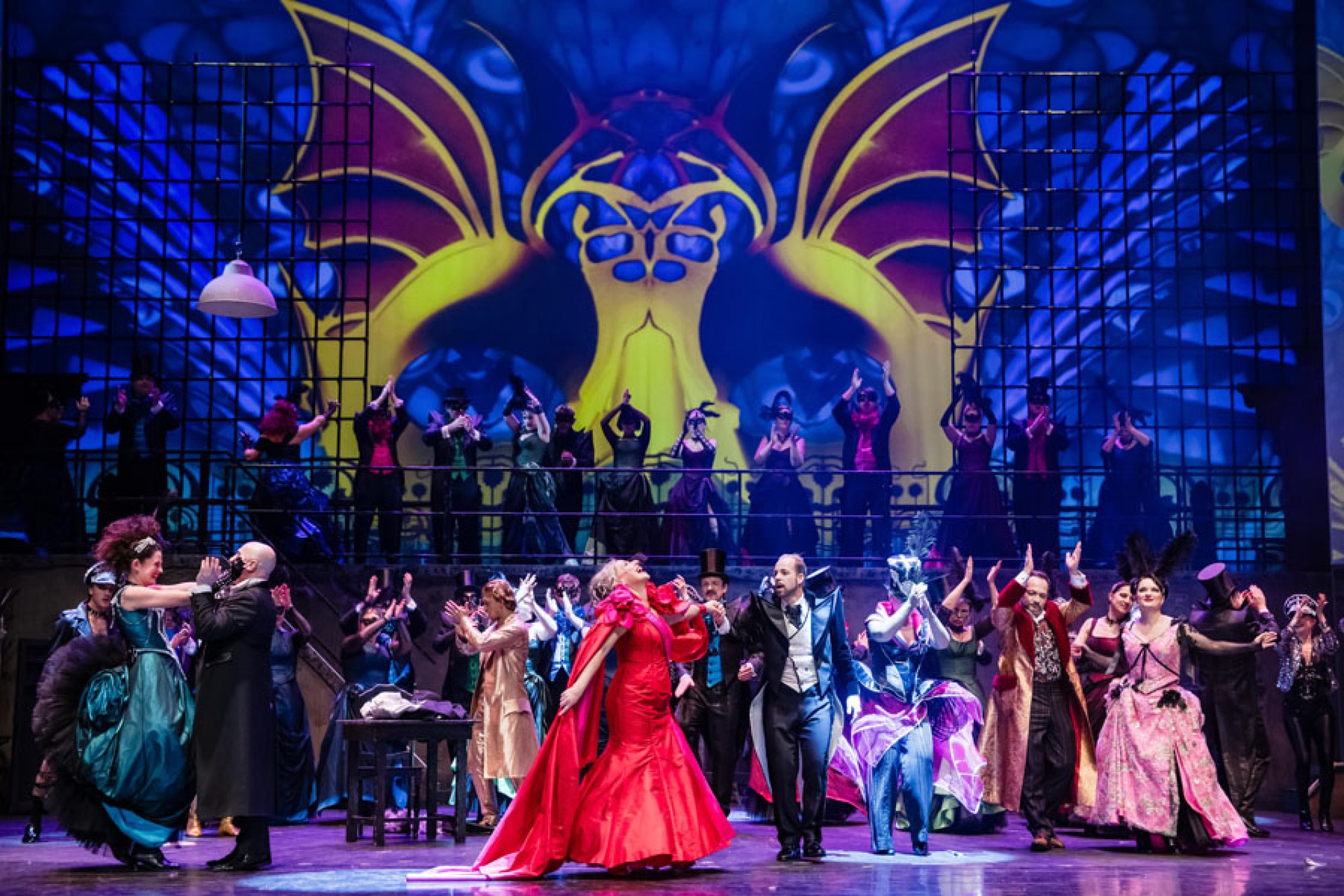
© Darja Stravs Tisu
The Bat
Order tickets
 February 2028 February 2028 | ||||||
|---|---|---|---|---|---|---|
Mo | Tu | We | Th | Fr | Sa | Su |
The story of intrigue, masking and sudden plot twists in sumptuous costumes entitled as The Bat is a genuine operetta gem and a famous masterpiece by »the waltz king« Johann Strauss, Jr. that has seen thousands of productions around the world. There is most probably no such an opera stage in the world on which this opera would not feature in all its grandeur the joyousness of the Viennese bourgeoisie of that time. Johann Strauss Son (1825-1899) was encouraged to compose operettas by Jacques Offenbach himself, who felt that the new stage genre suited the king of the Austrian light music down to the ground. The theatre of the 19th century was still not an elitist institution but rather a meeting place for all kinds of people. And his first attempt was already a great success – as his king Indigo and the Forty Thieves, which was premiered in 1871, made its way across the globe - to Paris (1875), London (1877) and New York (1891). It was followed by the Carnival in Rome, which Strauss composed for the Vienna World Exhibition in 1873. Its triumphant march across the European stages could not be stopped even by the severe economic depression that broke in those days. Then came The Bat. Its literary material was French – the famous duo Meilhac-Halévy, who was also responsible for the libretto of the Bizet's Carmen, launched the comedy Le Révellon in 1872. The play then found its way to the leaders of the Viennese Carl Teater, who were particularly interested in the Parisian novelties. It was translated into German by Karl Haffner, who moved its action to the »spa near the Austrian metropolis« (the spa he probably had in mind was Bad Ischl). Then the text mysteriously ended on the table of the director of the competitive Teater an der Wien Maximilian Steiner. Finally, the publishing agent Gustav Lewy came up with the idea that it would be best to remake it into an operetta and offer it to Johann Strauss. The matter started to unwind at the speed of light. Due to the almost complete financial collapse of the Habsburg Monarchy, the theatres were also plunged into a great distress; therefore Richard Gennée immediately signed the contract for the final draft of the text, whereas Strauss withdrew in his villa in Hietzing for six weeks to write the famous operetta. The world premiere in the Teater an der Wien (on 5th April 1874) was not accepted enthusiastically at all, as the reviews referred to it as »a potpourri of waltzes and polkas«. Much greater was its success in June, when staged in Berlin and in the same year The Bat appeared in New York as well. The audience finally recognised it as a genuine masterpiece.
Synopsis
Act 1
Eisenstein's apartment
Gabriel von Eisenstein, a Viennese man-about-town, has been sentenced to eight days in prison for insulting an official, partially due to the incompetence of his attorney, Dr. Blind. Adele, Eisenstein's maid, receives a forged letter, allegedly from her sister who is in the company of the ballet, but actually written by Eisenstein's friend Falke, inviting her to Prince Orlofsky's ball. She pretends the letter says that her aunt is very sick, and asks her mistress Rosalinde (Eisenstein's wife) for an evening off ("Da schreibt meine Schwester Ida"/"My sister Ida writes to me"). Falke arrives to invite him to the ball (Duet: "Komm mit mir zum Souper"/"Come with me to the supper"). Together, they recall a practical joke which Eisenstein played on Falke a few years ago, for which Falke is secretly planning a light-hearted revenge in kind. Eisenstein bids farewell to Adele and his wife Rosalinde, pretending he is going to prison (Trio: "O Gott, wie rührt mich dies!"/"Oh dear, oh dear, how sorry I am") but really intending to postpone jail for one day and have fun at the ball.
After Eisenstein leaves, Rosalinde is visited by her former lover, the singing teacher Alfred, who serenades her ("Täubchen, das entflattert ist"/"Dove that has escaped"). Frank, the governor of the prison, arrives to take Eisenstein to jail, and finds Alfred instead. In order not to compromise Rosalinde, Alfred agrees to pretend to be Eisenstein and to accompany Frank. (Finale, drinking song: "Glücklich ist, wer vergisst"/"Happy is he who forgets" followed by Rosalinde's defence when Frank arrives: "Mit mir so spät im tête-à-tête"/"In tête-à-tête with me so late", and Frank's invitation: "Mein schönes, großes Vogelhaus"/"My beautiful, large bird-cage".)
Act 2
A summer house in the Villa Orlofsky
It transpires that Falke, with Prince Orlofsky's permission, is using the ball as a way of getting revenge on Eisenstein. Some time before, after a costume-party, Eisenstein had abandoned Falke, very drunk and dressed in a bat-costume, in the center of town, exposing him to ridicule the next day. As part of his scheme, Falke has invited Frank, Adele, and Rosalinde to come the ball, all concealing their identities as well. Rosalinde pretends to be a masked Hungarian countess, Eisenstein goes by the name "Marquis Renard", Frank is "Chevalier Chagrin", and Adele, who has borrowed one of Rosalinde's dresses without permission, pretends she is an actress.
The ball is in progress (Chorus: "Ein Souper heut' uns winkt"/"A supper is before us") and the Prince welcomes his guests ("Ich lade gern mir Gäste ein"/"I love to invite my friends"). Eisenstein is introduced to Adele, but is confused as to who she really is because of her striking resemblance to his maid. ("Mein Herr Marquis"/"My lord marquis", sometimes referred to as "Adele's Laughing Song"). Frank arrives. He and Eisenstein, who are both posing as Frenchmen, attempt to conceal their identities by repeating common French phrases to each other, to Orlofsky's great amusement. Since neither actually knows French, both are fooled. As the party progresses, they both experience alcohol-induced good-feeling and manly camaraderie for each other.
Then Falke introduces the masked Rosalinde to the company. She convinces everyone that she is Hungarian by singing the "Czardas", a sentimental dancing-song ("Klänge der Heimat"/"Sounds from home"). During an amorous tête-à-tête, Eisenstein tries unsuccessfully to persuade the mystery-woman to unmask. She succeeds in extracting a valuable watch from her husband's pocket, something which she can use in the future as evidence of his impropriety. (Watch duet: "Dieser Anstand, so manierlich"/"Her bearing, so well-mannered"). In a rousing finale, Orlofsky makes a toast to champagne, and the company celebrates (The Champagne song: "Im Feuerstrom der Reben"/"In the fire stream of the grape"; followed by the canon: "Brüderlein, Brüderlein und Schwesterlein"/"Brothers, brothers and sisters" and the waltz finale, "Ha, welch ein Fest, welche Nacht voll Freud'!"/"Ha, what joy, what a night of delight".) Eisenstein and Frank dash off as the clock strikes six in the morning.
(Note: The "Champagne song", which is sung by the entire ensemble, should not be confused with the baritone aria "Fin ch' han dal vino" from Don Giovanni, which is often called the "Champagne aria".)
Act 3
In the prison offices of Warden Frank
The next morning they all find themselves at the prison where the confusion increases and is compounded by the jailer, Frosch, who has profited by Warden Frank's absence to become gloriously drunk. Alfred, still in jail in Eisenstein's place, irritates the other prisoners by singing operatic arias.
Adele arrives to ask the Chevalier Chagrin (actually Frank) to sponsor her career as an actress, but Frank is not wealthy enough to do this (Melodrama; Couplet of Adele: "Spiel' ich die Unschuld vom Lande"/"If I play the innocent peasant maid"). Meanwhile, Alfred asks Frosch to summon Dr. Blind to help get him released; Frank agrees to allow this and Dr. Blind arrives. Eisenstein enters and says he has come to serve his sentence. He is surprised when Frank tells him that his cell is already occupied by a man who claims to be Eisenstein and whom Frank had arrested in Eisenstein's apartment. Frank further tells Eisenstein that the man he arrested was singing amorous songs to Rosalinde at the time of his arrest, and warmly kissed her goodbye. Enraged, Eisenstein takes Dr. Blind's wig and glasses in order to disguise himself and confront the impersonator Alfred, who Eisenstein now believes has cuckolded him. Rosalinde enters. Eisenstein takes off his disguise and accuses her of being unfaithful to him with Alfred. Eisenstein, Rosalinde, and Alfred sing a trio in which Eisenstein angrily claims the right of vengeance (Trio: "Ja, ich bin's, den ihr betrogen...Ra-ra-ra-ra-Rache will ich!"/"I'm the one who was mistreated....Ve-ve-ve-ve-vengeance is mine!"). However, Rosalinde produces his watch, and he realizes that the Hungarian mystery-woman he tried to seduce at Orlofsky's party was actually Rosalinde in disguise and that he, not she, is at fault.
Falke enters with all the guests from the party and explains that the whole thing was payback for Eisenstein's practical joke on him three years before. Eisenstein is delighted by the prank, and he begs Rosalinde to forgive him for his attempted infidelity. Rosalinde refuses at first and threatens to divorce him, but Eisenstein tells her that his misbehavior was caused by the champagne. She accepts this explanation and immediately forgives him unconditionally. Orlofsky promises to finance Adele's acting career, and the company joyfully reprises the "Champagne song" from act 2.
Program and cast
Music: Johann Strauss Jr.
Libretto: Karl Haffner and Richard Genée after the vaudeville play Le réveillon/The New Year's Eve by Henri Meilhac and Ludovic Halevy (1872), based on the farce Das Gefängnis/The Prison by Julius Roderich Benedix (1851)
Sung Text Translation: Oton Župančič
Spoken Text Translation and Adaptation: Seta Knop
Conductor: Ayrton Desimpelaere
Stage Director: Krešimir Dolenčić
Choreographer: Lukas Zuschlag
Set Designer: Andrej Stražišar
Costume Designer: Alan Hranitelj
Lighting Designer: Andrej Hajdinjak
Sound Designer: Luka Berden
Video Projections: Stella Ivšek
Language Coach: Marja Filipčič Redžić
Choir Mistress: Željka Ulčnik Remic
Concertmaster: Gregor Traven
Assistant Conductor: Jakob Barbo
Assistant Stage Director: Simona Pinter
Assistant Choreographer: Olga Andreeva, Stefan Capraroiu
Assistant Set Designer: Vanesa Garpova
Assistant Costume Designer: Ana Janc
Répétiteurs: Kayoko Ikeda, Višnja Kajgana, Irena Zajec, Irina Milivojević, Stefan Pajanović, Marina Đonlić (chorus)
Prompters Dejan Gebert, Urška Švara Kafol
Stage Manager Roman Pušnjak
Cast
Eisenstein :Martin Sušnik k. g./ Matej Vovk
Rosalinda: Mojca Bitenc Križaj / Martina Zadro
Frank: Ivan A. Arnšek / Marko Ferjančič
Alfredo: Andrej Debevec k. g./ Dejan Maksimilijan Vrbančič
Falke: Rok Bavčar/ Slavko Savinšek
Blind: Gregor Ravnik k. g./ Edvard Strah
Orlovski: Margareta Matišić/ Norina Radovan/ Anja Zemljarič
Adela: Eva Černe Avbelj k. g./ Nina Dominko/ Štefica Grasselli
Ida: Ireneja Nejka Čuk/ Lora Pavletić
Frosch: Gojmir Lešnjak Gojc k. g.
Choir, ballet in orchestra SNG Opera in balet Ljubljana
Festival Ljubljana
SNT Opera and Ballet Ljubljana
Arrival
We kindly recommend you to arrive at the theatre on time. Only in this way you will be able to check in your belongings at the cloakroom, leaf through your theatre programme, find your seat and catch-up with your friends. Do not forget that the other visitors intend to do exactly the same, so please try to arrive at least 20 minutes before the scheduled performance time.
Location and Parking
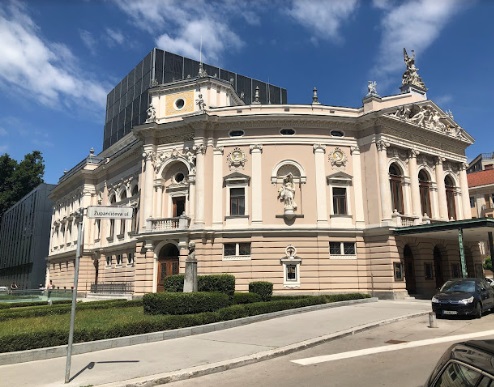
When planning your arrival time, please bear in mind that the building of the Slovenian National Theatre Opera and Ballet Ljubljana is located in the city centre. Three public payable car parks or parking places are available in the neighbouring streets. The closest open-air car park is located on the Republic Square, under which a parking garage is available as well. Three minutes walk away you will find another garage under the Congress Square. A bit longer walking time will be required for parking in the car park, located on the Trdinova Street.
Theatre Dress Code
Our dress code is primarily a way to express our respect to performers, other visitors and ourselves. In former times, a formal suit and tie for gentlemen and a smart dress for ladies were required, when visiting theatre, opera and ballet performances or concerts. In present times, the rules are not so strict any more, however, we would advise you against wearing casual or sporting clothes in the theatre.
Cloakroom
The cloakrooms are located in the Lower Lobby and on the Dress Circle level.
Mobile Phones and Watches
We kindly ask you to allow yourselves and other visitors to experience the performance in an undisturbed manner. Mobile phones and hand watches, making annoying sounds, should be left at home or turned off before the beginning of the performance.
Bringing in outside food and beverages
Outside food and beverages are not permitted in the theatre.
© Darja Stravs Tisu
Related events