
 EN
EN DE
DE IT
IT FR
FR ES
ES RU
RU JP
JP RO
RO
Claudio Baglioni
Order tickets
July 2026  | ||||||
|---|---|---|---|---|---|---|
Mo | Tu | We | Th | Fr | Sa | Su |
Claudio Baglioni announces GrandTour LA VITA È ADESSO in 2026.
The GrandTour LA VITA È ADESSO by Claudio Baglioni arrives, a live musical project that represents the culmination of the celebrations of the 40th anniversary of the album LA VITA È ADESSO, IL SOGNO È SEMPRE.
A special and exclusive event in a place of essential value in Baglioni’s life and career, marking the beginning of a journey that symbolically set out from that borderland marking the southernmost edge of Italy. In 2026, from late June to mid September, the GrandTour LA VITA È ADESSO will unfold in 40 extraordinary concerts, a symbolic number celebrating the 40th anniversary of the best selling album in the history of Italian music, in the most evocative open air settings across Italy. An important return, coming 15 years after Baglioni’s last tour in Italy’s magnificent outdoor venues.
This journey could only begin in an iconic place such as Piazza San Marco in Venice, opening the prestigious Festival della Bellezza and marking a historic debut for the artist.
Program and cast
Teatro Antico di Taormina
Ancient theatre of Taormina
Description
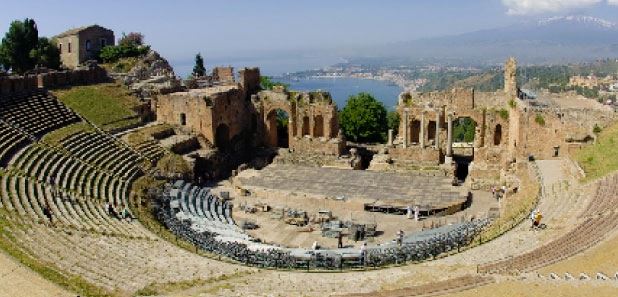
The ancient theatre (the teatro greco, or "Greek theatre") is built for the most part of brick, and is therefore probably of Roman date, though the plan and arrangement are in accordance with those of Greek, rather than Roman, theatres; whence it is supposed that the present structure was rebuilt upon the foundations of an older theatre of the Greek period. With a diameter of 120 metres (390 ft) (after an expansion in the 2nd century), this theatre is the second largest of its kind in Sicily (after that of Syracuse); it is frequently used for operatic and theatrical performances and for concerts. The greater part of the original seats have disappeared, but the wall which surrounded the whole cavea is preserved, and the proscenium with the back wall of the scena and its appendages, of which only traces remain in most ancient theatres, are here preserved in singular integrity, and contribute much to the picturesque effect, as well as to the interest, of the ruin. From the fragments of architectural decorations still extant we learn that it was of the Corinthian order, and richly ornamented. Some portions of a temple are also visible, converted into the church of San Pancrazio, but the edifice is of small size.

Related events