
 EN
EN DE
DE IT
IT FR
FR ES
ES RU
RU JP
JP RO
RO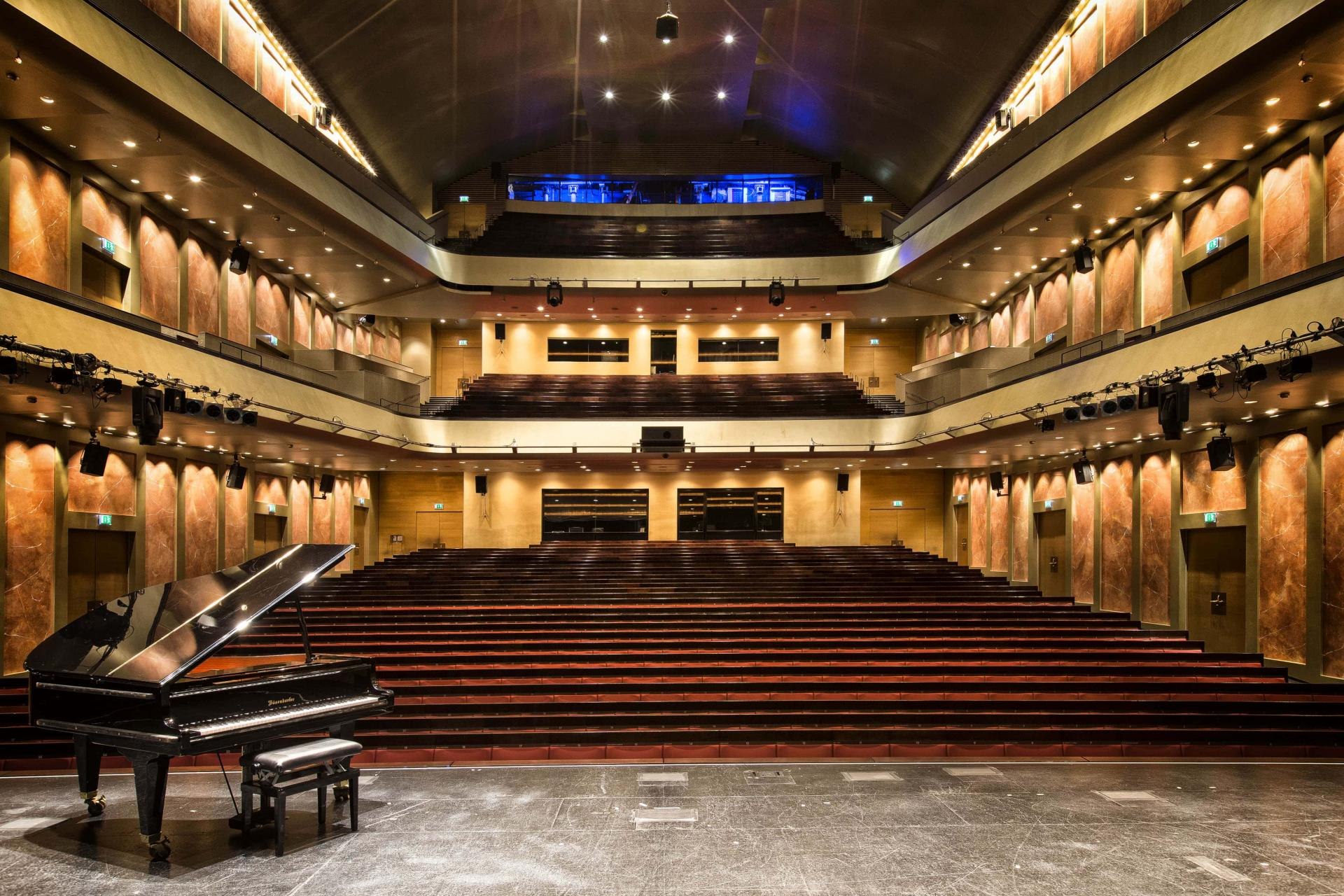
© Salzburger Festspiele / Andreas Kolarik
Il ritorno d'Ulisse in patria
Order tickets
 December 2035 December 2035 | ||||||
|---|---|---|---|---|---|---|
Mo | Tu | We | Th | Fr | Sa | Su |
About the Production
IL RITORNO D’ULISSE IN PATRIA
The Phaeacians have set the sleeping Ulysses down on the shores of Ithaca, and his long wanderings are almost over. Monteverdi’s opera Il ritorno d’Ulisse in patria depicts the last leg of Ulysses’s return from Troy: thanks to his divine protector Minerva, he reunites with his son Telemachus, then, disguised as an old beggar, sets out for the royal palace to destroy his wife’s power-hungry suitors. Penelope struggles to accept that the man to whom she has remained steadfastly faithful for 20 years is truly standing before her. From her heartrending lament in Act I onward, Monteverdi gives Penelope the same care and attention he devotes to the opera’s hero himself. The path to the couple’s joyful reunion is lined with helpful and hostile gods, loyal and less loyal servants, hypocritical suitors and a social parasite as grotesque as he is gluttonous. With his genius for musical characterization, Monteverdi conjures up a vivid tapestry of characters and events, which the Milanese puppet company Colla will bring to life on stage with delightful inventiveness.
Synopsis
The action takes place on and around the island of Ithaca, ten years after the Trojan Wars. English translations used in the synopsis are from Geoffrey Dunn's version, based on Raymond Leppard's 1971 edition, and from Hugh Ward-Perkins's interpretation issued with Sergio Vartolo's 2006 recording for Brilliant Classics. Footnotes provide the original Italian.
Prologue
The spirit of human frailty (l'humana Fragilità) is mocked in turn by the gods of time (il Tempo), fortune (la Fortuna) and love (l'Amore). Man, they claim, is subject to their whims: "From Time, ever fleeting, from Fortune's caresses, from Love and its arrows...No mercy from me!" They will render man "weak, wretched, and bewildered."
Act 1
In the palace at Ithaca, Penelope mourns the long absence of Ulysses: "The awaited one does not return, and the years pass by." Her grief is echoed by her nurse, Ericlea. As Penelope leaves, her attendant Melanto enters with Eurimaco, a servant to Penelope's importunate suitors. The two sing passionately of their love for each other ("You are my sweet life"). The scene changes to the Ithacan coast, where the sleeping Ulisse is brought ashore by the Phaecians (Faeci), whose action is in defiance of the wishes of gods Giove and Nettuno. The Phaecians are punished by the gods who turn them and their ship to stone. Ulysses awakes, cursing the Phaecians for abandoning him: "To your sails, falsest Phaeacians, may Boreas be ever hostile!" From the goddess Minerva, who appears disguised as a shepherd boy, Ulisse learns that he is in Ithaca, and is told of "the unchanging constancy of the chaste Penelope", in the face of the persistent importunings of her evil suitors. Minerva promises to lead Ulisse back to the throne if he follows her advice; she tells him to disguise himself so that he can penetrate the court secretly. Ulisse goes to seek out his loyal servant Eumete, while Minerva departs to search for Telemaco, Ulisse's son who will help his father reclaim the kingdom. Back at the palace, Melanto tries vainly to persuade Penelope to choose one of the suitors: "Why do you disdain the love of living suitors, expecting comfort from the ashes of the dead?" In a wooded grove Eumete, banished from court by the suitors, revels in the pastoral life, despite the mockery of Iro, the suitors' parasitic follower, who sneers: "I live among kings, you here among the herds." After Iro is chased away, Ulisse enters disguised as a beggar, and assures Eumete that his master the king is alive, and will return. Eumete is overjoyed: "My long sorrow will fall, vanquished by you."
Act 2
Minerva and Telemaco return to Ithaca in a chariot. Telemaco is greeted joyfully by Eumete and the disguised Ulisse in the woodland grove: "O great son of Ulysses, you have indeed returned!" After Eumete goes to inform Penelope of Telemaco's arrival a bolt of fire descends on Ulisse, removing his disguise and revealing his true identity to his son. The two celebrate their reunion before Ulisse sends Telemaco to the palace, promising to follow shortly. In the palace, Melanto complains to Eurimaco that Penelope still refuses to choose a suitor: "In short, Eurymachus, the lady has a heart of stone." Soon afterwards Penelope receives the three suitors (Antinoo, Pisandro, Anfinomo), and rejects each in turn despite their efforts to enliven the court with singing and dancing: "Now to enjoyment, to dance and song!" After the suitors' departure Eumete tells Penelope that Telemaco has arrived in Ithaca, but she is doubtful: "Such uncertain things redouble my grief." Eumete's message is overheard by the suitors, who plot to kill Telemaco. However, they are unnerved when a symbolic eagle flies overhead, so they abandon their plan and renew their efforts to capture Penelope's heart, this time with gold. Back in the woodland grove, Minerva tells Ulisse that she has organised a means whereby he will be able to challenge and destroy the suitors. Resuming his beggar's disguise, Ulisse arrives at the palace, where he is challenged to a fight by Iro, ("I will pluck out the hairs of your beard one by one!"), a challenge he accepts and wins. Penelope now states that she will accept the suitor who is able to string Ulisse's bow. All three suitors attempt the task unsuccessfully. The disguised Ulisse then asks to try though renouncing the prize of Penelope's hand, and to everyone's amazement he succeeds. He then angrily denounces the suitors and, summoning the names of the gods, kills all three with the bow: "This is how the bow wounds! To death, to havoc, to ruin!"
Act 3
Deprived of the suitors' patronage, Iro commits suicide after a doleful monologue ("O grief, O torment that saddens the soul!") Melanto, whose lover Eurimaco was killed with the suitors, tries to warn Penelope of the new danger represented by the unidentified slayer, but Penelope is unmoved and continues to mourn for Ulisse. Eumete and Telemaco now inform her that the beggar was Ulisse in disguise, but she refuses to believe them: "Your news is persistent and your comfort hurtful." The scene briefly transfers to the heavens, where Giunone, having been solicited by Minerva, persuades Giove and Nettune that Ulisse should be restored to his throne. Back in the palace the nurse Ericlea has discovered Ulisse's identity by recognising a scar on his back, but does not immediately reveal this information: "Sometimes the best thing is a wise silence." Penelope continues to disbelieve, even when Ulisse appears in his true form and when Ericlea reveals her knowledge of the scar. Finally, after Ulisse describes the pattern of Penelope's private bedlinen, knowledge that only he could possess, she is convinced. Reunited, the pair sing rapturously to celebrate their love: "My sun, long sighed for! My light, renewed!"
Program and cast
Dramma per musica in a prologue and three acts (1640)
Libretto by Giacomo Badoaro
New production
Cast
Vito Priante: Ulisse
Sara Mingardo: Penelope
Massimo Altieri: Telemaco
Arianna Vendittelli: Minerva
Alessandro Ravasio: Tempo / Nettuno
Raffaele Giordani: Giove / Eurimaco
Francesca Cassinari: Fortuna / Melanto
Jiayu Jin: Amore / Giunone
and others
Co-production with the Opéra de Monte-Carlo
Creative Team
Gianluca Capuano: Conductor
Ensembles
Compagnia Marionettistica Carlo Colla & Figli
Les Musiciens du Prince — Monaco
House for Mozart
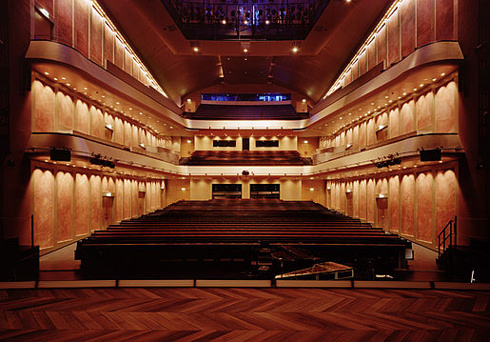
When it became clear that the ambitious plans to build a festival stage in Hellbrunn could not be realised, the idea was born of transforming parts of the court stables into a theatre. After a building period lasting only four months a provisional festival hall was built on the grounds of the large winter riding school in 1925 which was opened with Das Salzburger Grosse Welttheater. Only one year later, in 1926, the architect Clemens Holzmeister supervised a first phase of re-building of the inadequate provisional festival hall. Adaptations were again made in 1927 so that operas could be performed: Beethoven’s Fidelio was the first opera to be performed here.
The building was known as the Kleines Festspielhaus, and underwent several more reconstruction phases: in 1937 the auditorium was turned around by 180° which meant that it was necessary to build on a fly tower for the backstage area. In order to make this possible, the then governor of Salzburg, Franz Rehrl, allowed his birthplace in the Toscanini courtyard to be pulled down. Benno von Arent redesigned the festival hall in 1939 and replaced the wooden panelling with stucco work ornamented in gold. The unsatisfactory sight lines and acoustic problems made a further conversion necessary in the years 1962/63. The Salzburg architects Hans Hofmann and Erich Engels gave the hall the form it had until 2004.
For many years the Salzburg Festival had followed plans to create a “House for Mozart” which would in every respect be suitable for the performance of the composer’s stage works, with excellent acoustics and the best possible sight lines from all seats. The auditorium had to be both intimate but also have sufficient seating capacity. The task that seemed like squaring the circle was achieved by the team of architects Holzbauer and Valentiny: what was previously known as the Kleines Festspielhaus was transformed in three building phases from September 2003 into a Haus für Mozart (House for Mozart). The auditorium of the Kleines Festspielhaus was widened, shortened and lowered. Two new audience circles were created which extend on both sides of the hall as far as the stage. This creates the effect that the stage is framed on three sides by people in festive mood rather than by bare walls.
In comparison with the previous situation in the Kleines Festspielhaus the foyers have undergone major changes. Tall windows extending over two floors offer views from the main foyer to the city, and in the evenings the lighted interior of the theatre creates an inviting impression. The main foyer is dominated by a 17-metre high gilded lamella wall; through the openings a profile of Mozart’s head made of Swarovski crystal can be seen. The terrace above the hall construction had never been accessible to the public since its construction in 1924; now, with the new design, it has become part of the interval foyer. The arcade below is made predominantly of glass and means that the auditorium opens out on two sides instead of only one, as was the previous situation. Thus people can step out directly from the festival hall into the magnificent urban surroundings.
The festival lounge on the roof, the SalzburgKulisse, has become a great attraction (made possible by Gerhard Andlinger). The name in itself already suggests the splendid view offered from there to the old town centre of Salzburg. This lounge is furnished with pear-wood panelling; the tapestries in the alcoves are by Anton Kolig, a contemporary of Anton Faistauer.
The Faistauer Foyer has become a jewel of the new house (made possible by Herbert Batliner): the famous frescoes in this hall, which were created by the Salzburg painter Anton Faistauer in 1926, were removed after the Nazis marched into Austria and some of them were deliberately destroyed. Not until 1956 was it possible to re-mount them. For the opening of the Haus für Mozart they were thoroughly restored, and architecturally the foyer has been returned to its original historic design.
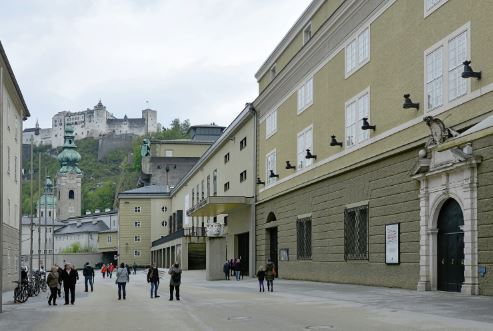
As regards the exterior façade the proportions of the Holzmeister ensemble from the years 1924/37 have been retained. The visual impression of the façade is characterised by the prestigious doors opening out onto the terrace which were designed by the sculptor Josef Zenzmaier: he created three bronze reliefs which are mounted above the portals and depict scenes from Mozart’s Le nozze di Figaro, Don Giovanni and Die Zauberflöte. The stone masks by Jakob Adlhart are now clearly visible above the entrance to the house: this is under the new extensive concrete roof decorated in gold leaf. Throughout the entire building rough concrete surfaces are contrasted with fine gold leaf, thus creating aesthetic tension.
From the backstage area a huge iron door opens onto the Toscanini courtyard. The six concrete reliefs mounted to the left and right Genies holding Masks were removed in 1938 but reconstructed again in 1979 by their creator Jakob Adlhart. Above them is an organ which was played for performances of Jedermann when they had to be transferred from the Domplatz to the Festspielhaus due to bad weather.
For the celebrations for Mozart’s 250th birthday in Mozart Year 2006 the Haus für Mozart was opened with the premiere of Le nozze di Figaro (conductor: Nikolaus Harnoncourt, stage director: Claus Guth).
Related events