


Saint François d’Assise

Order tickets
PreviousMay 2027
Mo
Tu
We
Th
Fr
Sa
Su


Scènes franciscaines

Opera in three acts and eight scenes
(created 1975—83, premiered in 1983)

Libretto by Olivier Messiaen

New production


Synopsis

Place: Italy.

Time: 13th century.

The subject of each scene is borrowed from the Fioretti and the Reflexions on the Stigmata, books written by anonymous Franciscans of the 14th century. There are seven characters: Saint Francis, the Leper, the Angel, Brother Elias, and three Brothers especially beloved of Saint Francis—Brother Leo, Brother Masseo, and Brother Bernard. Throughout the work one can see the progress of grace in the soul of Saint Francis.


Act 1

Scene 1: The Cross

After a short instrumental introduction, Saint Francis explains to Brother Leo that for the love of Christ he must patiently endure all contradictions, all suffering. This is the "Perfect joy."

Scene 2: Lauds

After the recitation of Matins by the Brothers, Saint Francis, remaining alone, prays that he might meet a leper and be capable of loving him.

Scene 3: The Kissing of the Leper

At a leper-hospital, a leper, horribly blood-stained and covered in pustules, rails against his disease. Saint Francis enters and, sitting close to him, speaks gently. An angel appears behind a window and says: "Leper, your heart accuses you, but God is greater than your heart." Troubled by the voice and by the goodness of Saint Francis, the leper is stricken with remorse. Saint Francis embraces him and, miraculously, the leper is cured and dances for joy. More important than the cure of the leper is the growth of grace in the soul of Saint Francis and his exultation at having triumphed over himself.


Act 2

Scene 4: The Journeying Angel

On a forest road on La Verna an angel appears, disguised as a traveler. His knocking on the door of the monastery makes a terrific sound, symbolising the inrush of Grace. Brother Masseo opens the door. The Angel asks Brother Elias, the vicar of the Order, a question about predestination. Brother Elias refuses to answer and pushes the Angel outside. The Angel knocks on the door again and puts the same question to Brother Bernard, who replies with much wisdom. The Angel having gone, Brother Bernard and Brother Masseo look at each other, Bernard remarking, "Perhaps it was an angel..."

Scene 5: The Angel-Musician

The Angel appears to Saint Francis and, to give him a foretaste of celestial bliss, plays him a solo on his viol. This solo is so glorious that Francis swoons.

Scene 6: The Sermon to the Birds

Set at Assisi, at the Carceri, with a large green oak tree in spring with many birds singing. Saint Francis, followed by Brother Masseo, preaches a sermon to the birds and solemnly blesses them. The birds reply with a great chorus in which are heard not only birds of Umbria, especially the blackcap, but also birds of other countries, of distant lands, notably the Isle of Pines, close to New Caledonia.


Act 3

Scene 7: The Stigmata

On La Verna at night in a cave beneath an overhanging rock, Saint Francis is alone. A great Cross appears. The voice of Christ, symbolized by a choir, is heard almost continuously. Five luminous beams dart from the Cross and successively strike the two hands, the two feet, and the right side of Saint Francis, with the same terrific sound that accompanied the Angel's knocking. These five wounds, which resemble the five wounds of Christ, are the divine confirmation of Saint Francis's holiness.

Scene 8: Death and the New Life

Saint Francis is dying, stretched out at full length on the ground. All the Brothers are around him. He bids farewell to all those he has loved, and sings the last verse of his Canticle of the Sun, the verse of "our sister bodily Death". The Brothers sing Psalm 141. The Angel and the Leper appear to Saint Francis to comfort him. Saint Francis utters his last words: "Lord! Music and poetry have led me to Thee [...] in default of Truth [...] dazzle me for ever by Thy excess of Truth..." He dies. Bells ring. Everything disappears. While the choir hymns the Resurrection, a patch of light illuminates the spot where the body of Saint Francis previously lay. The light increases until it becomes blinding; the choir altogether singing the word "joy". The curtain falls.


Program and cast

Sung in French with German and English surtitles


Creative Team

Maxime Pascal: Conductor 

Romeo Castellucci: Director / Sets / Costumes / Lighting 

Giulia Giammona: Artistic Collaborator 

Christian Longchamp: Dramaturgy 

Yasmine Hugonnet: Choreography

Alessio Valmori, Lisa Behensky: Associate Set Designers

Theresa Wilson: Associate Costume Designer 

Benedikt Zehm: Associate Lighting Designer 

Paul Jeukendrup: Sound Director 


Cast

Lauranne Oliva: L’Ange 

Philippe Sly: Saint François

Sean Panikkar: Le Lépreux 

Russell Braun: Frère Léon 

Léo Vermot-Desroches: Frère Massée

Aaron-Casey Gould: Frère Élie 

Willard White: Frère Bernard 
and others


Ensembles

Concert Association of the Vienna State Opera Chorus 

Jozef Chabroň: Chorus Master

Vienna Philharmonic 

Felsenreitschule

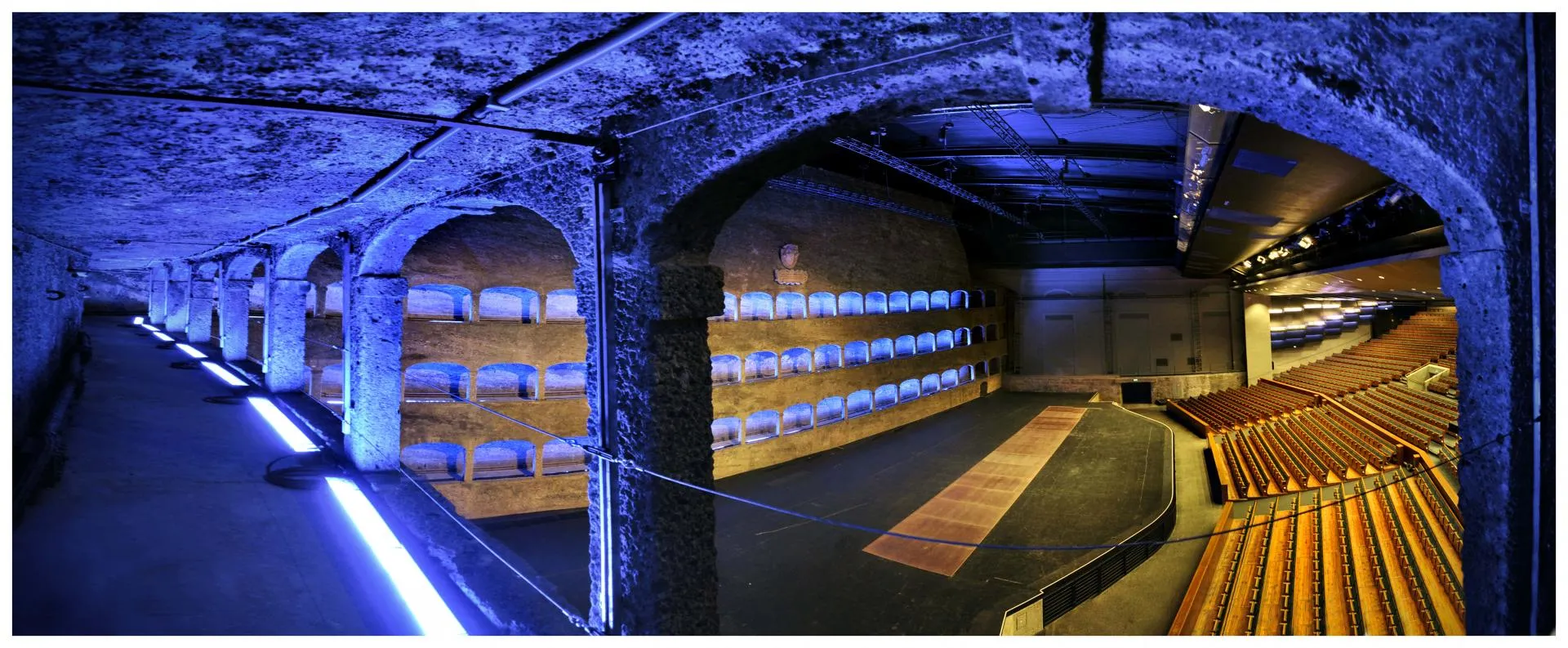
It was Max Reinhardt who suggested that the Winter Riding School should be converted, and it was also his idea to transform the Summer Riding School (Felsenreitschule) into a theatre. During the first half of the 17th century conglomerate rock was quarried here for the building of the cathedral. In 1693, during the reign of Prince-Archbishop Johann Ernst Thun, according to plans by the Baroque master architect Johann Bernhard Fischer von Erlach, three tiers of 96 arcades were hewn into the walls of the disused quarry so that from here people could watch equestrian displays and animal baiting events.


In 1926, when Max Reinhardt first attempted to use the Felsenreitschule to stage Goldoni’s Servant of Two Masters for the Salzburg Festival, the ambience was ideal for the “realistic” character comedy in the style of popular theatre: the action took place on a so-called Pawlatschenbühne, a small raised platform, the ground consisted of compressed earth and the audience sat on wooden benches. In 1933 Clemens Holzmeister built a remarkable set for the production of Faust in the Felsenreitschule, the Faust Town which is still regarded as one of the most impressive transformations of this venue. The first opera production in the Felsenreitschule took place in 1948 when Herbert von Karajan conducted Gluck’sOrfeo ed Euridice.


From the end of the 1960s radical conversion and adaptation work took place, mainly according to plans by the “festival architect” Clemens Holzmeister. An understage area, an orchestral pit and a lighting bridge were installed, a weatherproof roll-back roof to offer protection against rain and cool summer evenings, and finally an auditorium with boxes and circles as well as a depot for scenery were created.

Jean-Pierre Ponnelle’s staging of Mozart’s Die Zauberflöte, which was presented here every summer from 1978 to 1986, achieved legendary status. The same is true of Shakespeare’s plays Julius Caesar, Coriolanus and Anthony and Cleopatra in the productions by Peter Stein and Deborah Warner (Coriolanus),which in the early 1990s were internationally acclaimed.


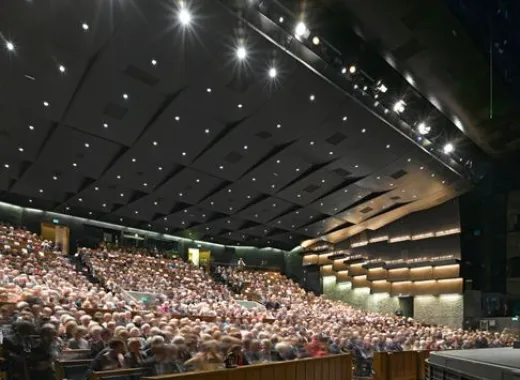
When the Haus für Mozart was built, the Felsenreitschule already received a new audience grandstand, which resulted in improved sightlines and acoustics for the audience.


Improvements are:

- A new roof construction with two fixed girders at the edges and three elements supported by five telescope cantilevers: the slightly inclined pitch roof consisting of three mobile segments resting on five telescope arms will be retractable and expandable within six minutes. Hanging points on the telescope cantilevers for stage technology (chain hoists), improved acoustical and heat protection and two lighting bridges will optimize the stage action.

-     New security technology including electrical installations, stage lighting, effect lighting and effect sound.

-     In addition, the interior expansion of the 3rd floor will be completed at that time, and the building shell of the newly constructed 4th floor under the roof of the Felsenreitschule will be made available to the Festival – this being the last instance in which new space can be created within the Festival District.

Related events