Plot
Euripides's play follows the fates of the women of Troy after their city has been sacked, their husbands killed, and their remaining families taken away as slaves. However, it begins first with the gods Athena and Poseidon discussing ways to punish the Greek armies because they condoned the rape of Cassandra, the eldest daughter of King Priam and Queen Hecuba and priestess of Apollo, by Ajax the Lesser after dragging her from a statue of Athena. What follows shows how much the Trojan women have suffered as their grief is compounded when the Greeks dole out additional deaths and divide their shares of women. The Greek herald Talthybius arrives to tell the dethroned queen Hecuba what will befall her and her children: Hecuba will be taken away to the Greek king Odysseus; the widowed princess Andromache's lot is to be the concubine of Neoptolemus, the son of the slain Greek warrior Achilles; and Cassandra is destined to become the conquering king Agamemnon's concubine.
Cassandra, who can see the future but is also cursed so that her visions of the future are never believed, is morbidly delighted by this news: she foresees that when they arrive in Argos, her new master's embittered wife Clytemnestra will kill both her new master and her before being killed herself by her own children. She sings a wedding song for herself and Agamemnon that describes their bloody deaths, and is taken away.
Andromache arrives, and Hecuba learns from her that her youngest daughter Polyxena has been killed as a sacrifice at the tomb of Achilles. But more horrible news for the royal family is yet to come. Talthybius reluctantly informs Andromache that her baby son Astyanax has been condemned to die: the Greek leaders are afraid that the boy will grow up to avenge his father Hector, and so rather than take this chance they plan to throw him off from the battlements of Troy to his death.
Helen is supposed to suffer greatly as well: Menelaus arrives to take her back to Greece with him where a death sentence awaits her. Helen tries to convince Menelaus that Aphrodite was the cause of her betrayal and that she should not be punished, but Hecuba counters that Helen is lying and has only ever been loyal to herself. While he remains resolved that he will slay her when they return to Greece, at the end of the play it is revealed that she is still alive; moreover, the audience knows from Telemachus' visit to Sparta in Homer's Odyssey that Menelaus continued to live with Helen as his wife after the Trojan War.
In the end, Talthybius returns, carrying with him the body of Astyanax on Hector's shield. Andromache's wish had been to bury her child herself, performing the proper rituals according to Trojan ways, but her ship had already departed. Talthybius gives the corpse to Hecuba, who prepares the body of her grandson for burial before they are finally taken off with Odysseus.
Throughout the play, many of the Trojan women lament the loss of the land that reared them. Hecuba in particular lets it be known that Troy had been her home for her entire life, only to see herself as an old grandmother watching the burning of Troy, the death of her husband, her children, and her grandchildren before she will be taken as a slave to Odysseus.
 en
en  de
de it
it fr
fr es
es ru
ru jp
jp ro
ro








 Greek Theatre of Syracuse
 Sat 08 May 2027 - Sat 05 Jun 2027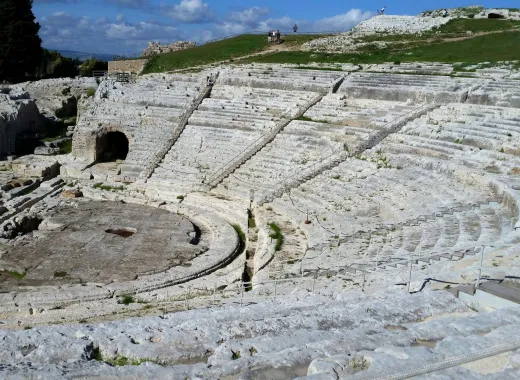



 RM EUROPA TICKET GmbH
 Call now
 Book now